
Age Verification Required
This website contains information about firearms and NFA items. You must be 21 years of age or older to enter.
By entering this site you agree to our Terms & Conditions
Firearms • Fingerprinting • Engraving
Sales@HoraceFirearms.comBy Appointment · Mon–Fri 10am–6pm
Follow Us


Thanks for your order — you're all set. We'll email you a receipt shortly, and we'll contact you within 1 business day to schedule your fingerprinting and Form 4 appointment.
Suppressors don't ship to your door — you'll pick yours up in person once ATF approval comes through, and we'll walk you through the entire process.
You will be returned to Horace Firearms shortly.
From basic mechanics to advanced materials and manufacturing — everything you need to know before buying your first suppressor, or your fifth.
A suppressor — also called a silencer — doesn't make a firearm silent. What it does is slow down and cool the expanding gases that follow a bullet out of the barrel. Those gases are what create the majority of the noise you hear when a gun fires.
When a round is fired, a massive volume of hot, high-pressure gas exits the barrel behind the bullet. Without a suppressor, that gas expands violently and instantly into open air — creating a sharp, loud report. A suppressor gives those gases somewhere to go before they hit open air, allowing them to expand gradually through a series of internal chambers, cool down, and exit at lower pressure and velocity.
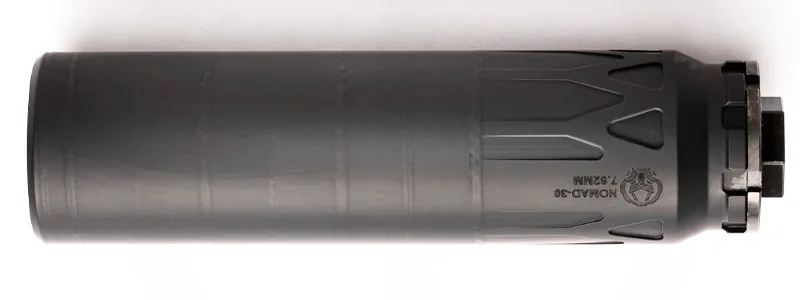
Think of it like a car muffler. Your car's engine produces exhaust gases at high pressure. The muffler routes those gases through a series of chambers and baffles that reduce pressure before the exhaust exits. A suppressor works on the same basic principle.
The result isn't silence — it's a significant reduction in sound. Most rifle suppressors bring a gunshot from around 160–165 dB down to 130–140 dB. That's still loud — comparable to a jackhammer — but a dramatic reduction that protects hearing and reduces noise pollution for neighbors and wildlife.
The Hollywood myth: In movies, suppressed firearms make a soft "pew" sound. In reality, supersonic ammunition still produces a loud crack from the bullet breaking the sound barrier — the suppressor only addresses the muzzle blast, not the sonic boom. Subsonic ammunition eliminates the crack, which is why .300 Blackout and 9mm are popular suppressor calibers.
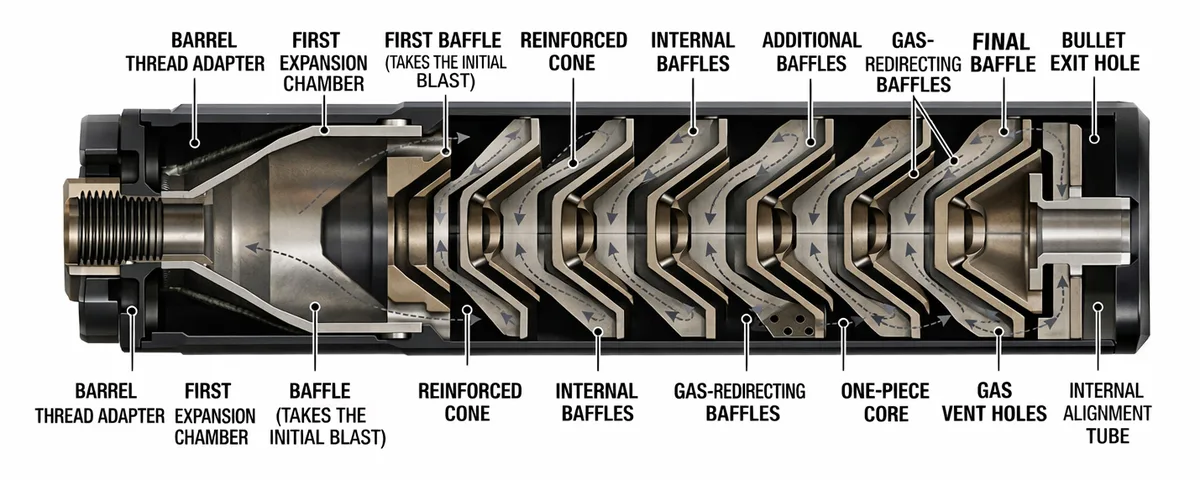
Cross-section of a traditional baffle stack suppressor — showing the threaded adapter, blast baffle, expansion chambers, internal baffles, gas vent holes, and bullet exit hole.
The internal design of a suppressor is what separates a great can from a mediocre one. There are three primary designs you'll encounter when shopping for a suppressor.
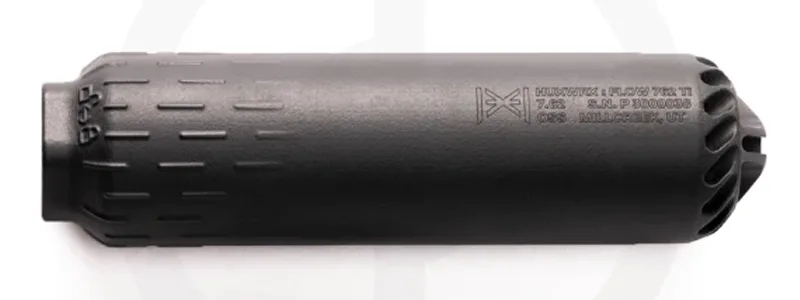
Which design is best? Depends on your priorities. Traditional baffle stacks and monocores offer the best raw decibel reduction. Flow-through sacrifices a few dB at the muzzle but delivers a dramatically cleaner shooting experience — no gas blowback, no cycling issues on finicky platforms.
For most shooters, a quality monocore or baffle stack is the right choice. For suppressing a piston rifle, an AK, or anything that tends to blow gas back into your face — flow-through is worth the premium.
The material a suppressor is made from determines its weight, durability, heat tolerance, and price. Here are the four materials you'll encounter most often.
Why does material matter so much? Inside a suppressor, temperatures can exceed 1,000°F during sustained fire. A material that can't handle that heat will erode, warp, or fail — sometimes catastrophically. The exotic materials cost more for a reason: they work when cheaper alloys would not.
How a suppressor is made is just as important as what it's made from. There are two primary manufacturing methods in use today.
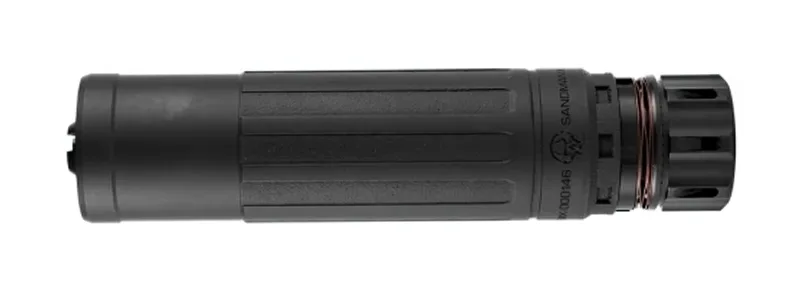
3D printing isn't a gimmick — it's genuinely enabling suppressor designs that weren't physically possible to manufacture before. The HUXWRX Flow series and Dead Air Sandman X both exist specifically because additive manufacturing allows internal gas flow geometries that no drill bit or mill can create.
DMLS stands for Direct Metal Laser Sintering — the specific 3D printing process used for metal suppressors. A high-powered laser fuses metal powder one thin layer at a time, building up the suppressor from the inside out. The result is a single, seamless piece with no welds and complex internal geometry.
Suppressors are designed for specific calibers and use cases. Here's a breakdown of the main categories.
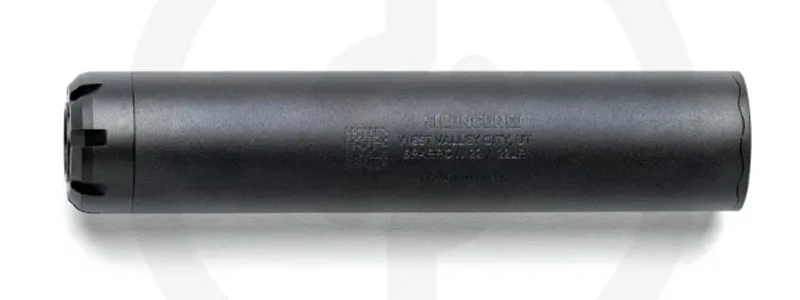
Can you use a rifle suppressor on a pistol? Sometimes — but not always. A multi-caliber suppressor rated for 9mm and .308 can often do both. A dedicated .308 rifle suppressor generally cannot be used on a pistol because it won't fit the threading and isn't rated for the pistol's cycling mechanism.
Can you use a pistol suppressor on a rifle? Only if the suppressor is specifically rated for rifle pressures — most aren't. Using a pistol suppressor on a rifle caliber can destroy the suppressor and cause injury.
Every suppressor has to attach to your barrel somehow. There are two basic approaches, and the right one depends on how you actually use the gun.
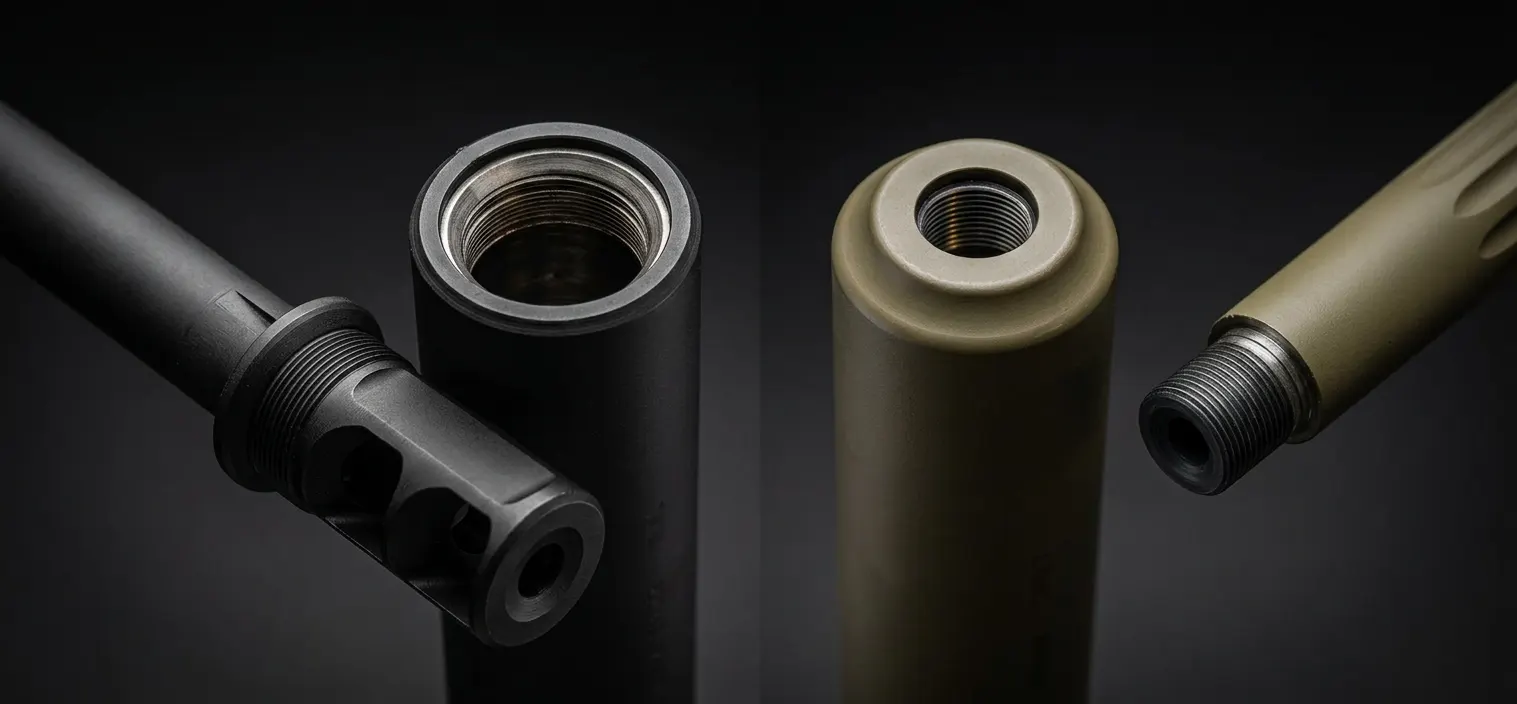
A note on QD systems: most brands run their own proprietary mount — KeyMo, Xeno, ASR, Dual-Lok, Torque Lock, and others aren't cross-compatible. Once you commit to a brand's QD system, your next suppressor from that brand mounts on the same hardware. Switch brands and you're often buying a new mount too.
User-serviceable vs. sealed matters just as much. User-serviceable suppressors — most rimfire cans and many pistol cans — have a removable baffle stack you can pull apart and clean. Most centerfire rifle suppressors are sealed: baffles are welded or pinned in permanently for strength and durability, and maintenance means an external solvent soak, not a teardown.
Most semi-auto pistols — Glock, and most other 9mm, .40, and .45 platforms — use a locked-breech, short-recoil action. The barrel and slide move together briefly before unlocking so the slide can cycle. Bolt a suppressor's weight directly onto that barrel via direct thread, and it can dampen the recoil impulse enough to cause cycling problems: failure to lock back, stovepipes, short-stroking.
A piston — also called a Nielsen device or booster — solves this. It's a spring-loaded unit that sits between the barrel and the suppressor. It lets the barrel move independently through its normal unlock cycle before the suppressor's mass engages, effectively isolating the can's weight from the pistol's operating system.
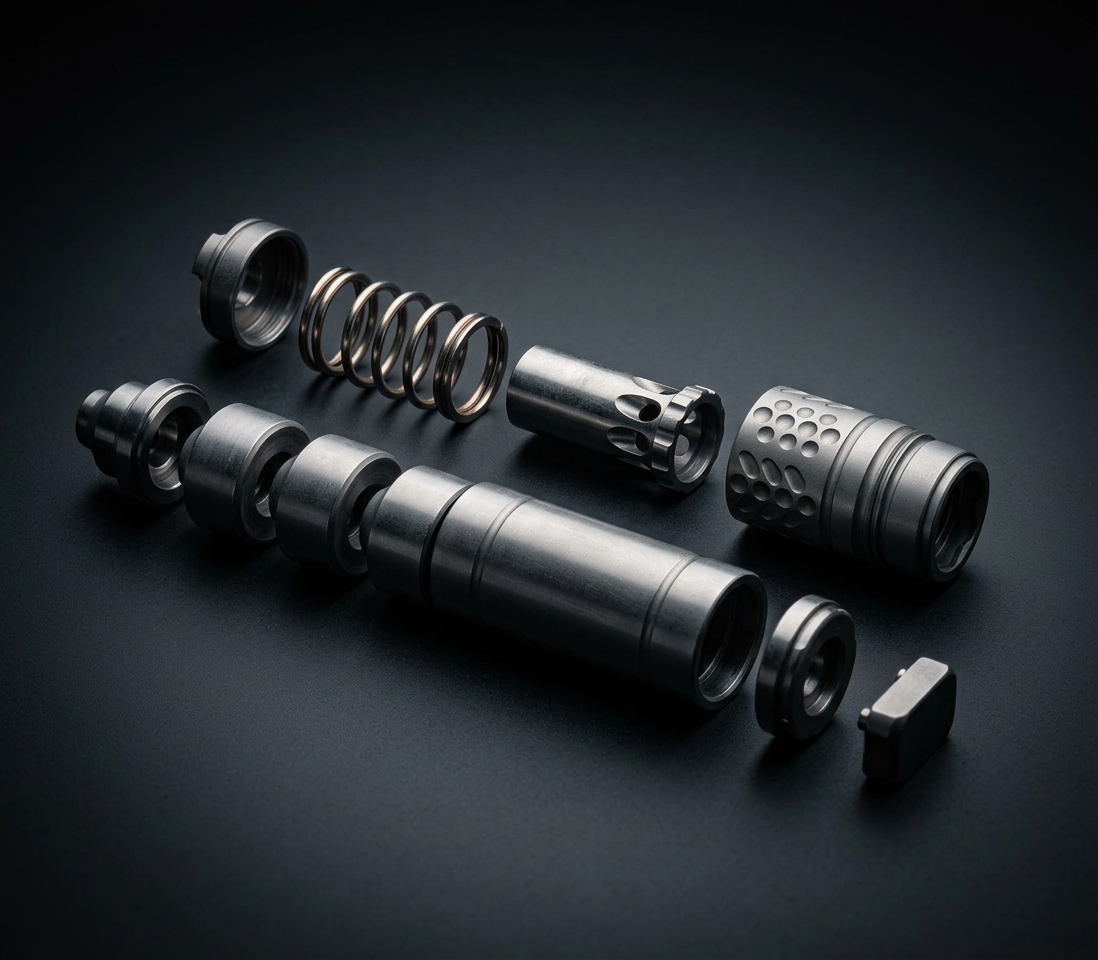
Not sure if your pistol needs a piston? Text us the make and model at 701-866-0050 and we'll tell you exactly what you need before you order.
With dozens of options across six brands, picking the right suppressor comes down to four questions.
Not sure which one is right for you? Text us the firearm you want to suppress and how you plan to use it. We'll give you a straight recommendation — no upsell, no pressure. 701-866-0050
Here's a representative selection from our lineup. We have access to nearly every suppressor made — if you don't see what you're looking for, text us.
17-4 stainless monocore, 14.5 oz, rated to .300 Norma Mag. The everyday do-everything rifle suppressor.
3D printed Haynes 282 superalloy. The most advanced baffle design Dead Air has ever produced.
3D printed titanium with flow-through technology. Gas goes forward, not in your face.
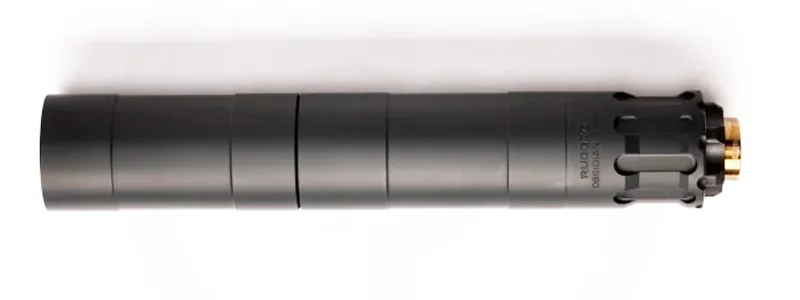
Modular long/short configuration. The top-rated 9mm suppressor on the market.
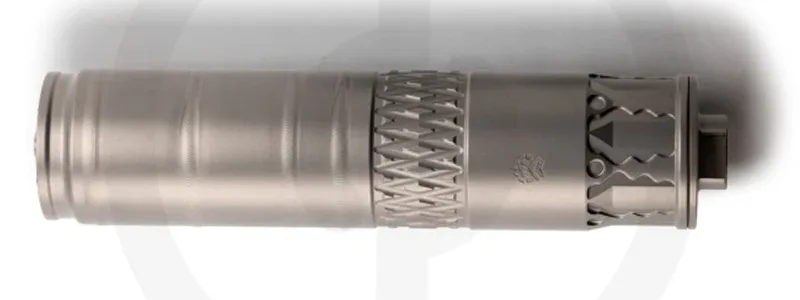
Full titanium, only 5.6 oz. Rated from 9mm pistols to .338 Lapua. Lightest multi-cal available.
The gold standard in rimfire suppression. Easy to clean, full-auto rated, covers .22 LR through 5.7x28.
Browse our full selection, or text us the suppressor you want and we'll confirm availability and pricing same day. No shipping, no transfer fee, digital fingerprinting done here — everything handled in one visit.
Questions about the NFA process? Read our NFA process guide →